



Skip to content

3D Parts Identification for Complex Equipment OEMs

Reduce ordering errors by up to 95%.

"The more complex the equipment became, the harder it was for customers to identify the right part from a traditional diagram.”

Help customers, dealers, and technicians identify the right parts faster with visual 3D experiences built for the way your aftermarket business works.

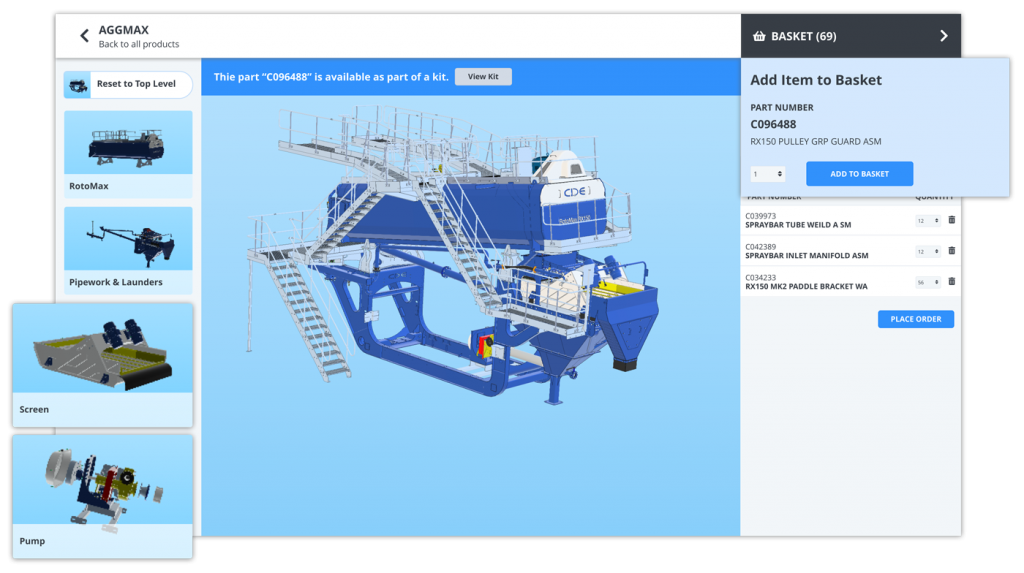
Whether you want to add 3D context to your existing parts catalogs or deliver a full 3D-first identification experience for complex equipment, Documoto and CADshare give OEMs a practical path toward more accurate, more intuitive aftermarket support.

cadhsare-blog-banner-image

Explore our 3D Parts Identification Options

cadhsare-blog-banner-image
Explore Documoto 2D and 3D Parts Identification
  • Parts catalogs that contain 2D, 3D or a blend of both content
  • Assembly level 3D models to enable lower level models to be used within interactive parts catalogs
cadhsare-blog-banner-image
Explore CADshare 3D Parts Identification
  • Machine level models for larger and more complex plant and equipment
  • CAD/PLM Integration for automated model upload pipelines
  • Advanced metadata processing

Why OEMs Are Moving Toward 3D Parts Identification

OEMs are under pressure to make parts identification faster, more accurate, and easier for every aftermarket user.

Traditional PDFs and static parts diagrams still play an important role, but they can be difficult to maintain, hard to navigate, and limited when equipment is complex, highly configurable, or visually difficult to interpret.

Customers, dealers, and service teams increasingly expect digital self-service experiences that help them find answers quickly and order with confidence. For manufacturers, that means finding better ways to connect visual product information with accurate parts data, service content, and ordering workflows.

Static catalogs slow users down

PDFs and traditional 2D diagrams often require users to interpret parts information manually. That can slow down technicians, frustrate customers, and create uncertainty when parts look similar or assemblies are difficult to understand.

Ordering errors create avoidable cost

When users cannot confidently identify the right part, incorrect orders can lead to returns, delays, additional support requests, and customer frustration.

Complex equipment needs better visual context

Large assemblies, similar-looking components, and configurable products can make it difficult to rely on static documentation alone. 3D gives users a clearer way to understand where a part belongs and how it relates to the full assembly.

Customers expect digital self service

Dealers, technicians, and equipment owners want intuitive tools that help them find parts, access information, and move forward without waiting for manual support.


Why 3D Matters More in the Aftermarket

Faster Parts Identification

Help users visually navigate equipment, understand assemblies, and locate parts more quickly.
 
With 3D, users can identify parts based on where they are located, how they fit into the surrounding assembly, and what they look like in the context of the full machine.


Fewer Ordering Errors

Reduce ambiguity before users submit a quote request or place an order.
 
When customers and dealers can visually confirm the part they need, they are more likely to order accurately the first time.

Better Customer Experience

Give aftermarket users a more modern, intuitive way to find parts and service information.

A visual 3D experience can build confidence, reduce frustration, and help customers move from identification to action faster.

Not sure which 3D path is right for your products and customers?

Documoto powers hundreds of the world's largest equipment brands across over 100 countries in 27 languages. See how Documoto can help you simplify publishing, improve dealer and customer experience, and create a source of truth for your aftermarket parts and service experience.